The Lightning Bolt on the Wall
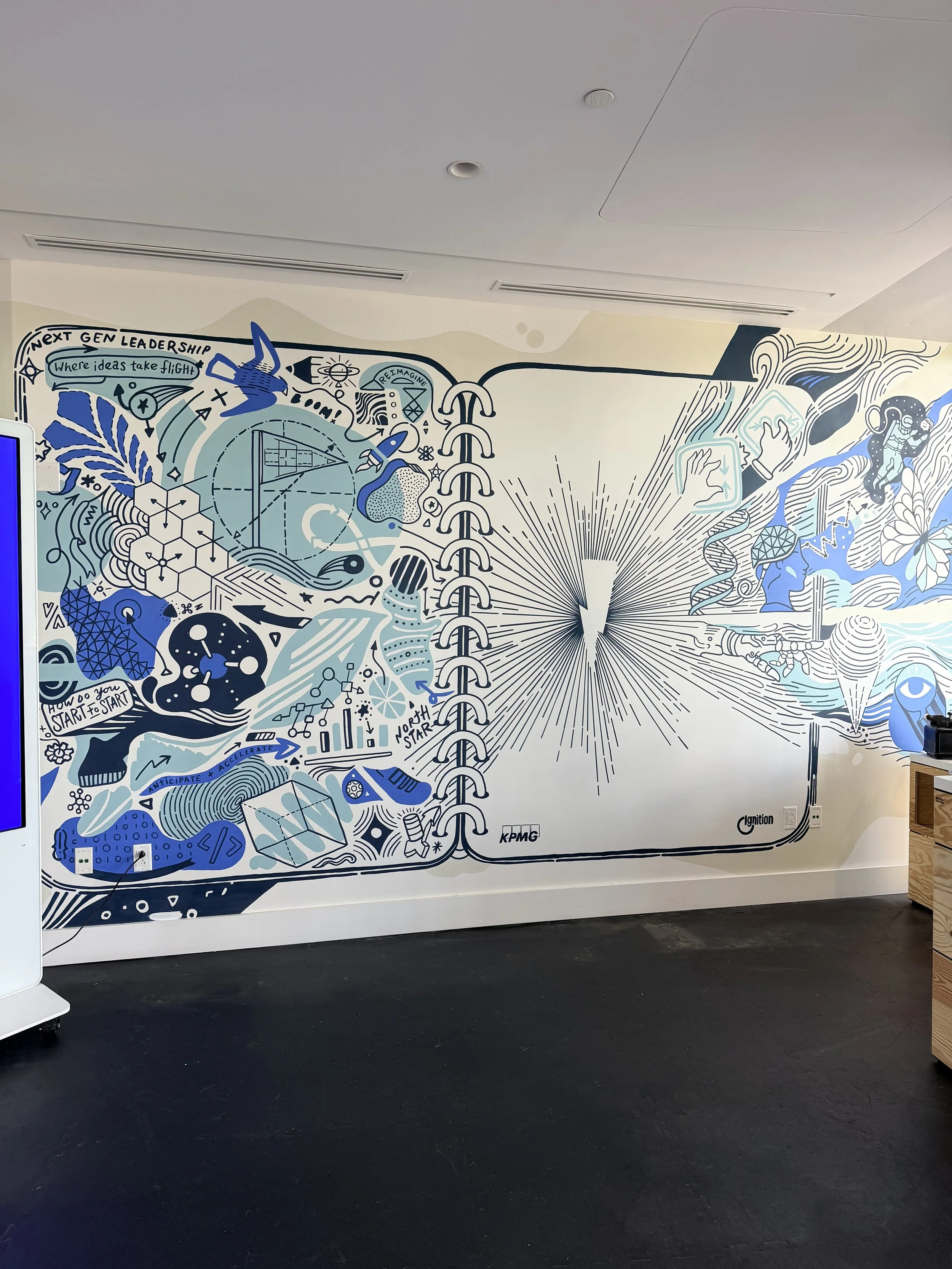
‘The Innovator’s Notebook’ // Mural install by Jesse Hora
A lightning bolt, a mural I had to fight for, and the quiet way a room decides who you get to be inside it.
When I was a kid, I drew lightning bolts. Constantly — in the margins of everything, next to the ice-skating costumes and the outfits I designed for people who didn't exist. I couldn't have told you why. A lightning bolt just felt like the shape of something about to happen.
Three decades later, I stood in our innovation lab in Lake Nona, Florida, and watched a muralist paint a lightning bolt onto the wall — right at the center of everything. It's the symbol we'd chosen for the aha moment. The spark. The half-second when a scattered idea finally lands.
Here's who I actually am: a creative director who's designed six innovation centers — the environmental branding, the story that lives on the walls. I partner with branding agencies to bring them to life, most recently Spark here in Chicago. I started as a classic graphic designer, and somewhere along the way I started morphing into something I didn't have a word for until recently: an environmental branding designer. And yes, I do all of this inside a corporate firm — not where people expect this kind of passion to come from. But that firm is exactly what handed me the opportunity: to grow, to chase challenges, to explore a part of myself I didn't know was there. I've gotten to make these spaces come alive, and I know how rare that is.
But here's what I've come to believe, and it's the reason I'm writing this at all: the room you're sitting in right now is shaping how you think. It always is. The only question is whether anyone designed it to.
That's what environmental branding actually is. Not decoration. Not "color for color," as I catch myself saying in meetings. It's the deliberate storytelling of a space — through art, through wayfinding, through the graphics on the walls and the path you walk to get there. Done with intention, it does something we rarely ask a room to do. It transports you. You cross a threshold and some part of you goes, oh. Something different happens here.
I learned this building innovation centers — labs, essentially, where people step out of their day-to-day to solve problems in a deeper, faster, sometimes stranger way than their normal desk would ever allow. And the tools of that work move fast. What felt cutting-edge in 2020 — the sticky notes, the whiteboards, the wall of Sharpies — is table stakes now. But one thing never stopped mattering: the space itself. When everyone can technically do the work from their kitchen table, the room has to earn the trip. It has to be so undeniably different that "why can't I just do this from home?" answers itself the second you walk in.
That's the part I fell in love with. Because a space designed with intention doesn't just look nice. It builds trust. It gives people a strange, welcome permission to be a little vulnerable — to say the half-formed thing, to think out loud, to share what they'd never risk in a normal office. You can't put that on a slide. You have to build it into the walls.
Which is how I ended up fighting — genuinely fighting — for a mural.
If you've never been in a room where people argue about murals, I promise you they do. Hand-drawn or stenciled. Painted or paint markers. Everyone has an opinion about how it should be made and what it's allowed to say. I fought for ours because I couldn't shake the feeling that the space needed something with a pulse — something you couldn't get from a logo on a wall.
I found that pulse in a Chicago muralist named Jesse Hora. What I loved about working with Jesse was that he already understood the thing I'm always trying to explain: environmental branding, design, and art aren't separate ingredients. They have to move together to create a feeling — a vibe, an energy — so that the moment you step inside, before anyone's said a word to you, you already know you're somewhere that expects something of you.
We built the mural around an idea we called the Innovator's Notebook. Think about the notebook every inventor, designer, tinkerer, and daydreamer carries — the one full of scraps and sketches and words that don't make sense yet. That was mine growing up: the lightning bolts, the costumes, the geometry, the shapes I couldn't stop drawing. The whole concept was that a page like that is chaos until, slowly, it isn't. The scattered ideas start forming paths. This outcome or that one. Door number one, door number two. We drew those paths as human-led possibilities blended with technology — what becomes possible when the two work together instead of one replacing the other. And at the center of all of it, where every path converges, we put the aha moment.
The lightning bolt.
The same shape I'd been drawing since I was small, now standing for the exact thing that room was built to create.
What I love about art in a space is that it refuses to mean just one thing. Someone walks in and sees my lightning bolt as a spark. Someone else sees a lion, or a memory, or a conversation they once had, or a dream they'd half-forgotten. The mural doesn't tell them what to think. It gives them somewhere to put what they're already carrying. That's the tool. That's why I fight for it.
And it doesn't start at the walls. The story starts the moment someone arrives — how they're greeted, whether a name badge is waiting, whether a barista hands them a coffee, whether someone reaches for their coat and their bag and makes the trip feel worth taking. That whole journey is the brand. The walls just finish the sentence.
So, why should you care about any of this? Because the spaces we move through are quietly telling us who we're allowed to be inside them. Most of them are saying sit down, stay small, get through it. I've spent fifteen years becoming convinced we can build rooms that say something braver — rooms that make people feel, the second they walk in, that they've stepped somewhere change is possible.
I'm still figuring out how to say all of it. But I know it starts with a kid, a notebook, and a lightning bolt she couldn't stop drawing — long before she knew what it meant.
