Found objects
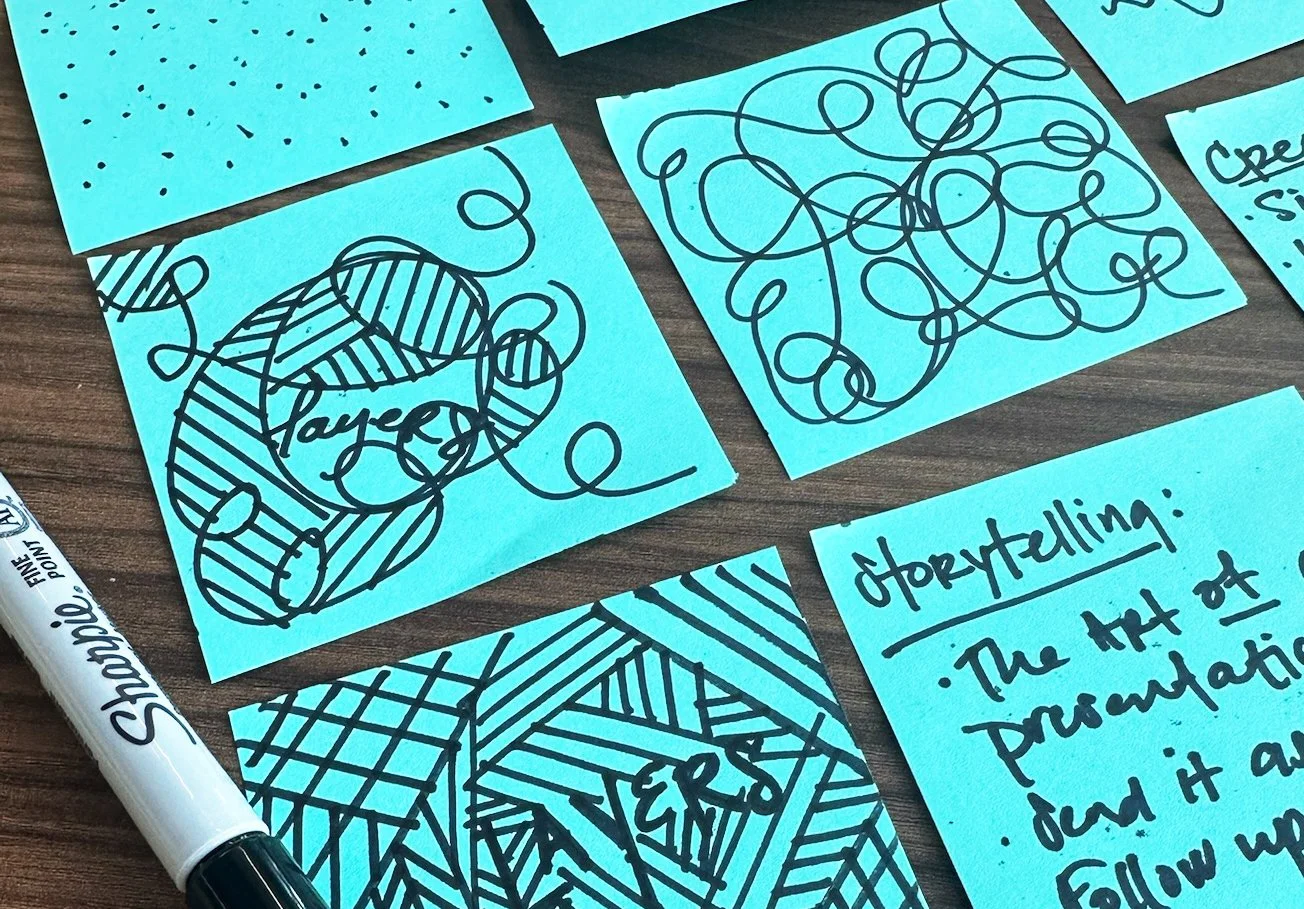
Grief, design, and the quiet work of making something out of what's left behind.
My niece in Michigan had a birthday recently, and a friend gave her a book I'd never heard of: a junk journal. My first thought was, is this a thing? Apparently, it's been a thing for a long time, and a lot of ten-, eleven-, twelve-year-olds already know about it. I was the one behind.
The idea is simple. The book has a page for every week. Each week you walk around your house and gather whatever's lying around — a length of ribbon, a scrap of wrapping paper, a crossword clipped from the newspaper, a button, a sticker — and you arrange it all on the page like a small, private mood board. Then you write next to it. How does this make me feel? What kind of week was it? What am I looking forward to? What do I wish I had? That's the whole exercise. You glue down the leftovers of an ordinary life and you say something true about them.
My niece got the book because she's a creative kid and her friend wanted to give her something fun. That was the whole reason — no subtext, no occasion beyond a birthday. And that's how she received it: as a game, a craft, a nice thing to do on a Sunday afternoon.
I received it completely differently, because of when it arrived.
I'd been in Michigan with family for a while by then. My mother-in-law had been in the hospital — very ill, but we thought she was turning a corner. We thought she was getting better right up until she wasn't. She passed away, and it left a hole that was bigger than I'd let myself imagine it would be. Cavernous is the word I keep coming back to. Not a gap you step over. A thing with depth.
So there I was, holding a craft book about collecting ribbon and buttons, and instead of a game I saw a method. What if the found objects weren't random? What if, for the first few weeks, you went looking for the things that reminded you of the person you lost — her handwriting, a recipe card, a color she always wore — and you put those down on the page instead? What if the prompt beside them wasn't what am I looking forward to but what do I miss, and what do I want to carry forward?
I work in design, which might be why my mind went there. When I don't know how to feel about something, I tend to make something about it. Not because making fixes anything — it doesn't — but because it gives the feeling a shape I can look at from the outside. A blank page is unbearable. A page with one honest object glued to it is a start.
I want to be careful here. I'm not a therapist. I don't specialize in grief, and I'd never tell anyone there's a correct way to move through the worst weeks of their life. But I've come to believe there's something real in processing loss through art and design — something soulful, even — and that it's more available to people than they assume. You don't need talent. You need a shoebox of scraps and a willingness to be honest for ten minutes.
The other thing I've been sitting with is that grief isn't only about death. We reserve the word for funerals, but the same hollowness shows up in smaller, less permitted forms. You grieve the phase your child used to be in or the role you used to have when you're moved into a new one. You grieve the version of yourself who ran the old company when you start the new one. You grieve a city, a chapter, a title on a business card, a way your days used to be organized. Nobody sends a card for that kind of loss, but it's a loss, and it asks to be processed too.
What I like about the junk-journal idea, and about creative work in general, when grief is the reason for it — is that it doesn't ask you to arrive anywhere. It just asks you to begin. Begin with an object. Begin with a memory. Begin with the color she wore. Then, week by week, without forcing it, the pages start to move. The ribbon that reminded you of her becomes a ribbon you like for its own sake again. The writing shifts, quietly, from what I lost to what I'm building. That's the transformation, and you can't schedule it — but you can make a place for it to happen.
I don't think design conquers grief. I think it keeps you company inside it and gives your hands something to do while the rest of you catches up. That's not nothing. When the hole is cavernous, a page with one true thing on it is a way of saying: I'm still here, and I'm still making.
My niece is filling her journal with birthday things — bright paper, good stickers, the small joys of being her age. I think I'm going to start one too. Mine will begin somewhere heavier. But if I keep going, I suspect the pages will eventually lead the same direction hers do: forward.
